Most glorious night! Thou wert not sent for slumber!Lord Byron
I guess some would agree with Byron on that... but only some....
..
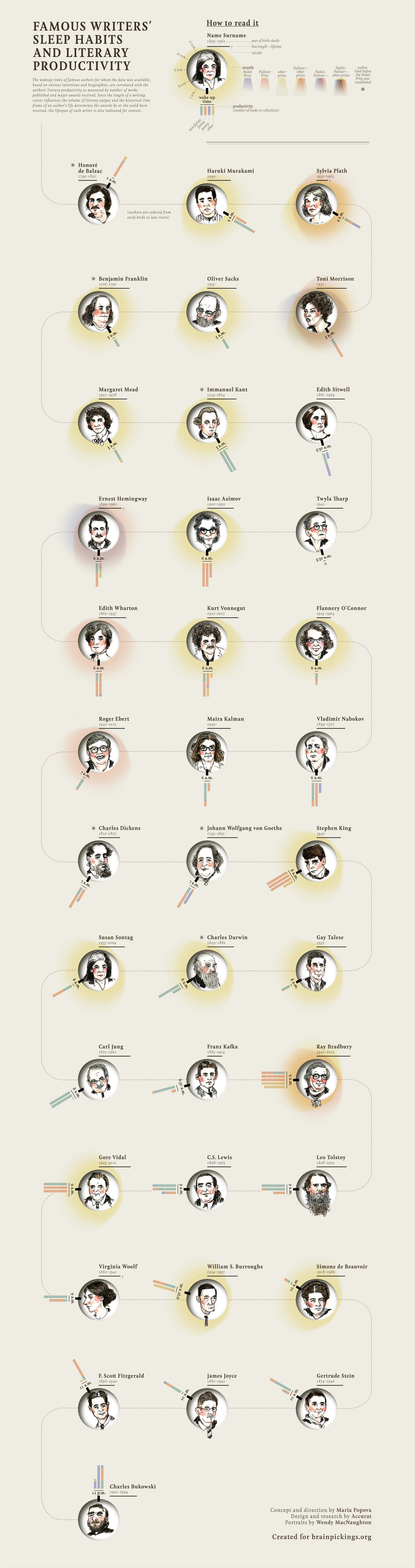
Have a look at the facts first: how did (do) writers view it?

If you have problems viewing it correctly try this website
Writers' sleep habits
You may also get some useful tips from the Kinfolk article: "Before the Day Starts".
"Frank Lloyd Wright developed his architectural designs from 4 to 7 a.m.,
and Immanuel Kant meditated over a pipe and weak tea before heading to the
local university to teach science."
"Proust slept during the day and worked through the night, George Gershwin
came home after evening parties to compose music until dawn, and George Sand
often left her lovers’ beds to write in the midnight silence that inspired her."
OR
BBC article about M. Thatcher
Can people get by on four hours' sleep?
The article on the website is rather long, so here is its student-friendly version:
Thatcher: Can people get by on four
hours' sleep?
Margaret
Thatcher is famously said to have slept for only four hours a night. How easy
is it to do a high-powered job on this amount of sleep?
Her
biographer John Campbell, author of The Iron Lady, says her late-to-bed,
early-to-rise routine made her the "best informed person in the
room".
Sleep
comes to be seen as part of a leader's character. When Napoleon Bonaparte was
asked how many hours sleep people need, he is said to have replied: "Six
for a man, seven for a woman, eight for a fool."
Churchill
survived on four hours a night during the war. But what is less often noted is
that he had regular afternoon naps in his pyjamas. Lady Thatcher was not one
for these afternoon sleeps. "No, she wasn't a napper," Ingham says.
In the world of business it is certainly something people strive for. High-profile chief executives from Marissa Mayer at Yahoo! to Pepsi's Indra Nooyi get by on four hours a night, while Donald Trump claims to survive on three.
Geraint Anderson, author of City Boy, who worked as an analyst and stockbroker for 12 years, recognises the phenomenon."There was a real macho competition in the City about sleep. One of the ways of getting respect was bragging about how little you got."
The
hours were long - from 6.30 in the morning to seven at night. Socialising might
mean staying out till three in the morning.
As
well as business, there have been military leaders who eschewed the eight hours
and opted for the Spartan Thatcher credo. General David Petraeus ate one meal a
day and slept only four hours a night.
There's
no correct amount of sleep, says Prof Kevin Morgan, of Loughborough
University's sleep research centre. The only rule is to sleep long enough to
feel refreshed when you wake up.
I would like to draw your attention to the interesting tidbits:
- Madonna is a long-term insomniac, which she blames on "being a workaholic and a film star, singer and mother all in one"
- Charles Dickens tackled his sleeplessness with long nocturnal walks, on one occasion tramping all the way from north London to Kent
- Rolling Stones guitarist Keith Richards once stayed awake for nine consecutive days - and then collapsed so quickly he broke his nose
Here come discussion questions:
1. What is your favourite time of day?
2. When do you feel most alert at dawn or at dusk?
3. What is it that you normally do first thing in the morning and last thing at night?
4. When was the last time you got up at the crack of dawn?
5. Do you tend to remember your dreams? What are they like? Do you dream in colour/sound? Any premonitory dreams?
6. Do you know/ have a recipe for a good night's sleep?
7. Do you take power naps?
Vocabulary-wise this topic opens up possibilities of letting students become familiar with:
at dawn * at dusk *
mid-afternoon * mid-morning * at midday *
at midnight *at sunrise * at
sunset*
at noon * at twilight *
at daybreak * in the middle of the night
* in the wee hours
and
take a nap
° sleep tight ° not
to sleep a wink ° sleep like a log ° to doze off
° to have a sleepless night
° sleep soundly °
to nod off ° to oversleep
And finally, time for a video:
Here is what I have come across while browsing TED lessons worth sharing:
Good luck to all the larks and owls!

No comments:
Post a Comment